Sunday, March 29, 2009


Saturday, March 28, 2009
suture

„Images are not created to express imaginary unity, but difference.
The ontological difference between image, object and subject becomes the point of departure, the suture.“
 valie export


Tuesday, March 10, 2009

Friday, February 27, 2009

Sunday, February 22, 2009

Friday, February 13, 2009


Tuesday, February 3, 2009
a hell of a tester

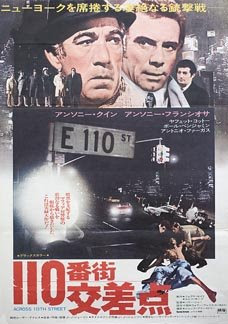


i was the third brother of five,
Doing whatever I had to do to survive.
I'm not saying what I did was alright,
Trying to break out of the ghetto was a day to day fight.
Been down so long, getting up didn't cross my mind,
I knew there was a better way of life that I was just trying to find.
You don't know what you'll do until you're put under pressure,
Across 110th Street is a hell of a tester.
Across 110th Street,
Pimps trying to catch a woman that's weak
Across 110th Street,
Pushers won't let the junkie go free.
Across 110th Street,
Woman trying to catch a trick on the street.
Across 110th Street,
You can find it all in the street.
I got one more thing I'd like to y'all about right now.
Hey brother, there's a better way out.
Snorting that coke, shooting that dope man you're copping out.
Take my advice, it's either live or die.
You've got to be strong, if you want to survive.
The family on the other side of town,
Would catch hell without a ghetto around.
In every city you find the same thing going down,
Harlem is the capital of every ghetto town.
Across 110th Street,
Pimps trying to catch a woman that's weak
Across 110th Street,
Pushers won't let the junkie go free.
Across 110th Street,
A woman trying to catch a trick on the street, ouh baby
Across 110th Street,
You can find it all in the street.
Yes he can, oh
Look around you, just look around you,
Look around you, look around you, uh yeah.
Doing whatever I had to do to survive.
I'm not saying what I did was alright,
Trying to break out of the ghetto was a day to day fight.
Been down so long, getting up didn't cross my mind,
I knew there was a better way of life that I was just trying to find.
You don't know what you'll do until you're put under pressure,
Across 110th Street is a hell of a tester.
Across 110th Street,
Pimps trying to catch a woman that's weak
Across 110th Street,
Pushers won't let the junkie go free.
Across 110th Street,
Woman trying to catch a trick on the street.
Across 110th Street,
You can find it all in the street.
I got one more thing I'd like to y'all about right now.
Hey brother, there's a better way out.
Snorting that coke, shooting that dope man you're copping out.
Take my advice, it's either live or die.
You've got to be strong, if you want to survive.
The family on the other side of town,
Would catch hell without a ghetto around.
In every city you find the same thing going down,
Harlem is the capital of every ghetto town.
Across 110th Street,
Pimps trying to catch a woman that's weak
Across 110th Street,
Pushers won't let the junkie go free.
Across 110th Street,
A woman trying to catch a trick on the street, ouh baby
Across 110th Street,
You can find it all in the street.
Yes he can, oh
Look around you, just look around you,
Look around you, look around you, uh yeah.
Wednesday, January 28, 2009


Saturday, January 24, 2009
well, no one told me about her

Well, no one told me about her
The way she lied
Well, no one told me about her
How many people cried
But it's too late to say you're sorry
How would I know, why should I care?
Please don't bother trying to find her
She's not there
Well, let me tell you 'bout the way she looked
The way she acts and the color of her hair
Her voice was soft and cool, her eyes were clear and bright
But she's not there
Well, no one told me about her
What could I do?
Well, no one told me about her
Though they all knew
But it's too late to say you're sorry
How would I know, why should I care?
Please don't bother trying to find her
She's not there
Well, let me tell you about the way she looked
The way she acts and the color of her hair
Her voice was soft and cool, her eyes were clear and bright
But she's not there
SOLO
But it's too late to say you're sorry
How would I know, why should I care?
Please don't bother trying to find her
She's not there
Well, let me tell you about the way she looked
The way she acts and the color of her hair
Her voice was soft and cool, her eyes were clear and bright
But she's not there

Monday, January 19, 2009
As far as Chō-fū-Sa

The River-Merchant's Wife: A Letter
by Ezra Pound
After Li Po
While my hair was still cut straight across my forehead
I played about the front gate, pulling flowers.
You came by on bamboo stilts, playing horse,
You walked about my seat, playing with blue plums.
And we went on living in the village of Chōkan:
Two small people, without dislike or suspicion.
At fourteen I married My Lord you.
I never laughed, being bashful.
Lowering my head, I looked at the wall.
Called to, a thousand times, I never looked back.
At fifteen I stopped scowling,
I desired my dust to be mingled with yours
Forever and forever, and forever.
Why should I climb the look out?
At sixteen you departed
You went into far Ku-tō-en, by the river of swirling eddies,
And you have been gone five months.
The monkeys make sorrowful noise overhead.
You dragged your feet when you went out.
By the gate now, the moss is grown, the different mosses,
Too deep to clear them away!
The leaves fall early this autumn, in wind.
The paired butterflies are already yellow with August
Over the grass in the West garden;
They hurt me.
I grow older.
If you are coming down through the narrows of the river Kiang,
Please let me know beforehand,
And I will come out to meet you
As far as Chō-fū-Sa.
.jpg)
Thursday, January 15, 2009
bridge
“Isn’t that like a bridge, of which only the beginning and the end exists, and which one nonetheless so confidently walks over as though all of it were there?”
Robert Musil

Joseph Kosuth
Tuesday, January 13, 2009

Wednesday, January 7, 2009
Don Fabrizio

We were the Leopards, the Lions,
those who'll take our place will be little jackals, hyenas;
and the whole lot of us, Leopards, jackals, and sheep,
we'll all go on thinking ourselves the salt of the earth.
Don Fabrizio
Sunday, December 21, 2008

Monday, December 15, 2008
a harbour teeming

Your hair holds a whole dream of masts and sails; it holds seas whose monsoons waft me toward lovely chimes where space is bluer and more profound, where fruits and leaves and human skin perfume the air.
In the ocean of your hair I see a harbour teeming with melancholic songs, with lusty men of every nation, and ships of every shape, whose elegant and intricate structures stand out against the enormous sky, home of eternal heat.
On the burning hearth of your hair I breathe in the fragrance of tobacco tinged with opium and sugar; in the night of your hair I see the sheen of the tropic's blue infinity; on the shores of your hair I get drunk with the smell of musk and tar and the oil of coconuts.
baudelaire
Phaedo

The Death of Socrates, from Plato's Phaedo
Then he turned to us, and added with a smile: "I cannot make Crito believe that I am the same Socrates who has been talking and conducting the argument; he fancies that I am the other Socrates whom he will soon see, a dead body--and he asks, How shall he bury me? And though I have spoken many words in the endeavor to show that when I have drunk the poison I shall leave you and go to the joys of the blessed--these words of mine, with which I was comforting you and myself, have had, as I perceive, no effect upon Crito. And therefore I want you to be surety for me to him how, as at the trial he was surety to the judges for me: but let the promise be of another sort; for he was surety for me to the judges that I would remain, and you must be my surety to him that I shall not remain, but go away and depart; and then he will suffer less at my death, and not be grieved when he sees my body being burned or buried. I would not have him sorrow at my hard lot, or say at the burial, Thus we lay out Socrates, or Thus we follow him to the grave or bury him; for false words are not only evil in themselves, but they infect the soul with evil. Be of good cheer then, my dear Crito, and say that you are burying my body only, and do with that whatever is usual, and what you think best."
When he had spoken these words, he arose and went into a chamber to bathe; Crito followed him and told us to wait. So we remained behind, talking and thinking of the subject of discourse, and also of the greatness of our sorrow; he was like a father of whom we were being bereaved, and we were about to pass the rest of our lives as orphans. When he had taken the bath his children were brought to him (he had two young sons and an elder one); and the women of his family also came, and he talked to them and gave them a few directions in the presence of Crito; then he dismissed them and returned to us.
Now the hour of sunset was near, for a good deal of time had passed while he was within. When he came out, he sat down with us again after his bath, but not much was said. Soon the jailer, who was the servant of the eleven, entered and stood by him, saying: "To you, Socrates, whom I know to be the noblest and gentlest and best of all who ever came to this place, I will not impute the angry feelings of other men, who rage and swear at me, when, in obedience to the authorities, I bid them drink the poison--indeed, I am sure that you will not be angry with me; for others, as you are aware, and not I, are to blame. And so fare you well, and try to bear lightly what must needs be--you know my errand." Then bursting into tears he turned away and went out.
Socrates looked at him and said: "I return your good wishes, and will do as you bid." Then turning to us, he said, "How charming the man is: since I have been in prison he has always been coming to see me, and at times he would talk to me, and was as good to me as could be, and now see how generously he sorrows on my account. We must do as he says, Crito; and therefore let the cup be brought, if the poison is prepared; if not, let the attendant prepare some."
"Yet," said Crito, "the sun is still upon the hilltops, and I know that many a one has taken the draught late, and after the announcement has been made to him, he has eaten and drunk, and enjoyed the society of his beloved; do not hurry--there is time enough."
Socrates said: "Yes, Crito, and they of whom you speak are right in so acting, for they think that they will be gainers by the delay; But I am right in not following their example, for I do not think that I should gain anything by drinking the poison a little later; I should only be ridiculous in my own eyes for sparing and saving a life which is already forfeit. Please then to do as I say, and not to refuse me."
Crito made a sign to the servant, who was standing by; and he went out, and having been absent for some time, returned with the jailer carrying the cup of poison. Socrates said: "You, my good friend, who are experienced in these matters, shall give me directions how I am to proceed."
The man answered: "you have only to walk about until your legs are heavy, and then to lie down, and the poison will act."
At the same time he handed the cup to Socrates, who in the easiest and gentlest manner, without the least fear or change of color or feature, looking at the man with all his eyes, . . . as his manner was, took the cup and said: "What do you say about making a libation out of this cup to any god? May I, or not?"
The man answered: "We only prepare, Socrates, just so much as we deem enough."
"I understand," he said; "but I may and must ask the gods to prosper my journey from this to the other world--even so--and so be it according to my prayer.
Then raising the cup to his lips, quite readily and cheerfully he drank off the poison. And hitherto most of us had been able to control our sorrow; but now when we saw him drinking, and saw too that he had finished the draught, we could not longer forbear, and in spite of myself my own tears were flowing fast; so that I covered my face and wept, not for him, but at the thought of my own calamity in having to part from such a friend. Nor was I the first; for Crito, when he found himself unable to restrain his tears, had got up, and I followed; and at that moment, Apollodorus, who had been weeping all the time, broke out in a loud and passionate cry which made cowards of us all.
Socrates alone retained his calmness: "What is this strange outcry?" he said. "I sent away the women mainly in order that they might not misbehave in this way, for I have been told that a man should die in peace. Be quiet then, and have patience."
When we heard his words we were ashamed, and refrained our tears; and he walked about until, as he said, his legs began to fail, and then he lay on his back, according to the directions, and the man who gave him the poison now and then looked at his feet and legs; and after a while he pressed his foot hard, and asked him if he could feel; and he said, "No;" and then his leg, and so upwards and upwards, and showed us that he was cold and stiff. And he felt them himself, and said: "When the poison reaches the heart, that will be the end."
He was beginning to grow cold about the groin, when he uncovered his face, for he had covered himself up, and said--they were his last words--he said: "Crito, I owe a cock to Asclepius; (1) will you remember to pay the debt?
"The debt shall be paid," said Crito; "is there anything else?"
There was no answer to this question; but in a minute or two a movement was heard, and the attendants uncovered him; his eyes were set, and Crito closed his eyes and mouth.
Such was the end . . . of our friend; concerning whom I may truly say, that of all the men of his time whom I have known, he was the wisest and justest and best.
Translated by Banjamin Jowett (1892)
(1) The god of health and medicine.
Wednesday, December 3, 2008


All knowledge, the totality of all questions and all answers, is contained in the dog.
—Franz Kafka
Outside of a dog, a man's best friend is a book. Inside of a dog, it's Too dark To read.
—Groucho Marx
"Dogs don't make mistakes."
-Sherlock Holmes
My mother groan'd! my father wept.
Into the dangerous world I leapt;
Helpless, naked, piping loud,
Like a fiend hid in a cloud.
—William Blake, "Infant Sorrow"
oh keep the Dog far hence, that's friend to men,
or with his nails he 'll dig it up again!
You! hypocrite lecteur! mon semblable,- mon frere!
-T.S Eliot
By the dog!
-Socrates
or with his nails he 'll dig it up again!
You! hypocrite lecteur! mon semblable,- mon frere!
-T.S Eliot
By the dog!
-Socrates
I wanna be your dog.
—The Stooges
Subscribe to:
Posts (Atom)